Economic Nutrition: Know Where Your Money Goes
Economic Nutrition is a Shorefast certification mark, a nutrition-style label that shows where your money goes when you spend at a business. I designed the brand and built the digital platform behind it, from the public directory to the internal engine that generates every label.
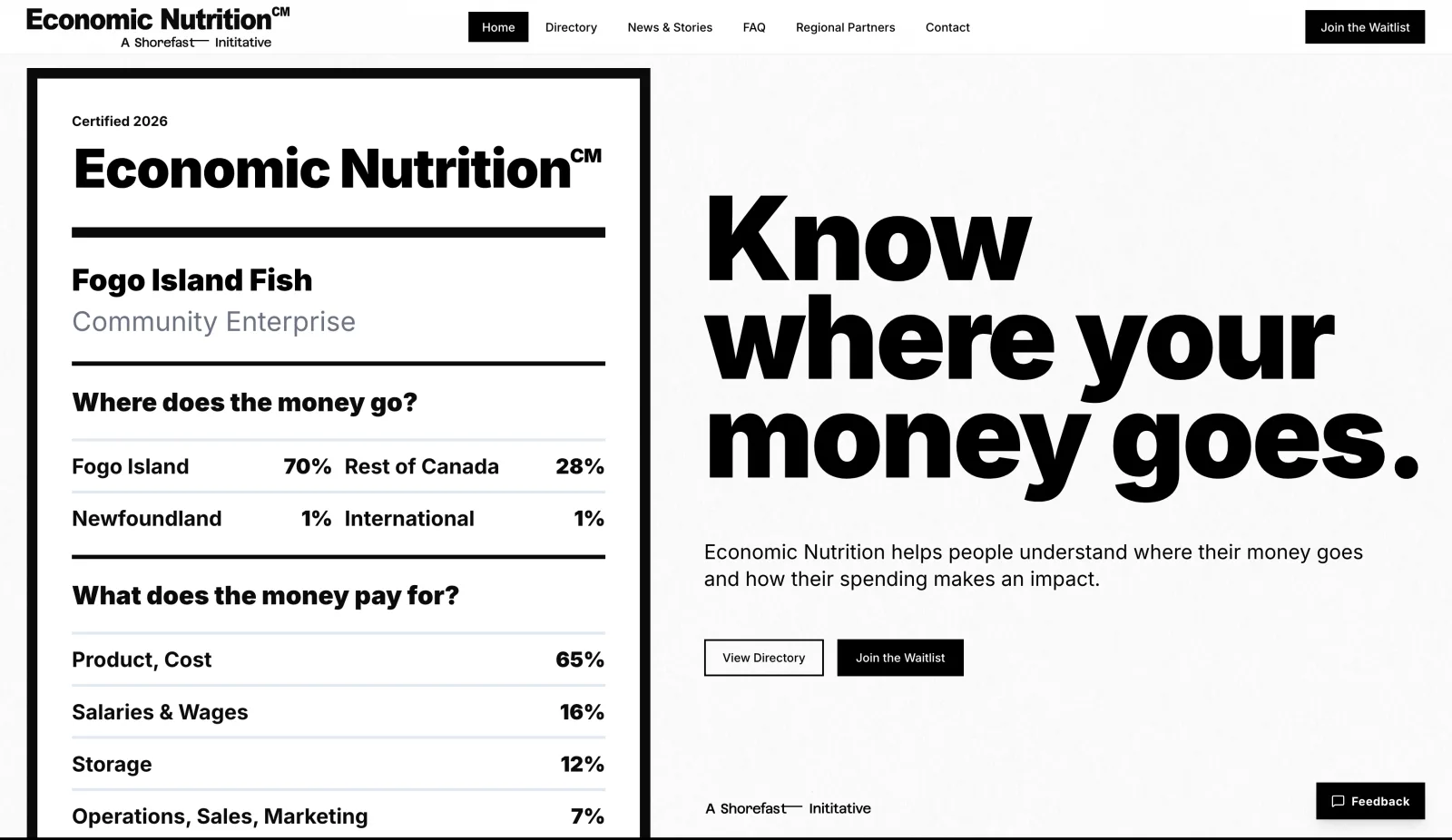
Economic Nutrition is a simple idea with real weight: take the nutrition label everyone knows from food and put it on a business. Instead of calories and fat, it shows where your money goes when you spend there and what it pays for, so anyone can see the local impact of a purchase at a glance.
It is a Shorefast certification mark, born from a question the organization kept asking about its own community enterprises: where does the money actually go? I designed the brand and its guidelines, and built the digital platform that turns that question into a certified, shareable label, from the public site to the internal engine that generates every label.
A Label You Already Know How to Read
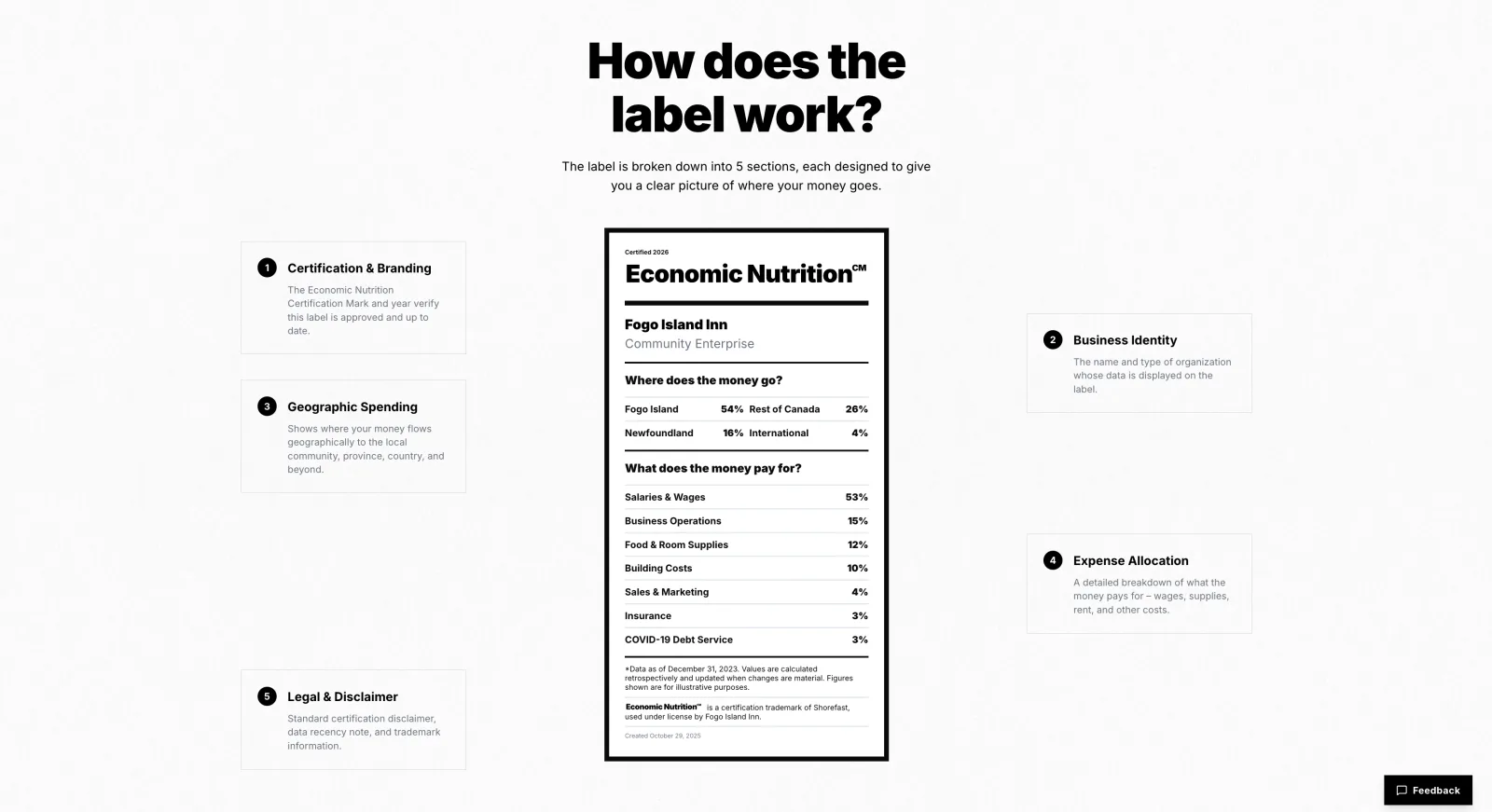
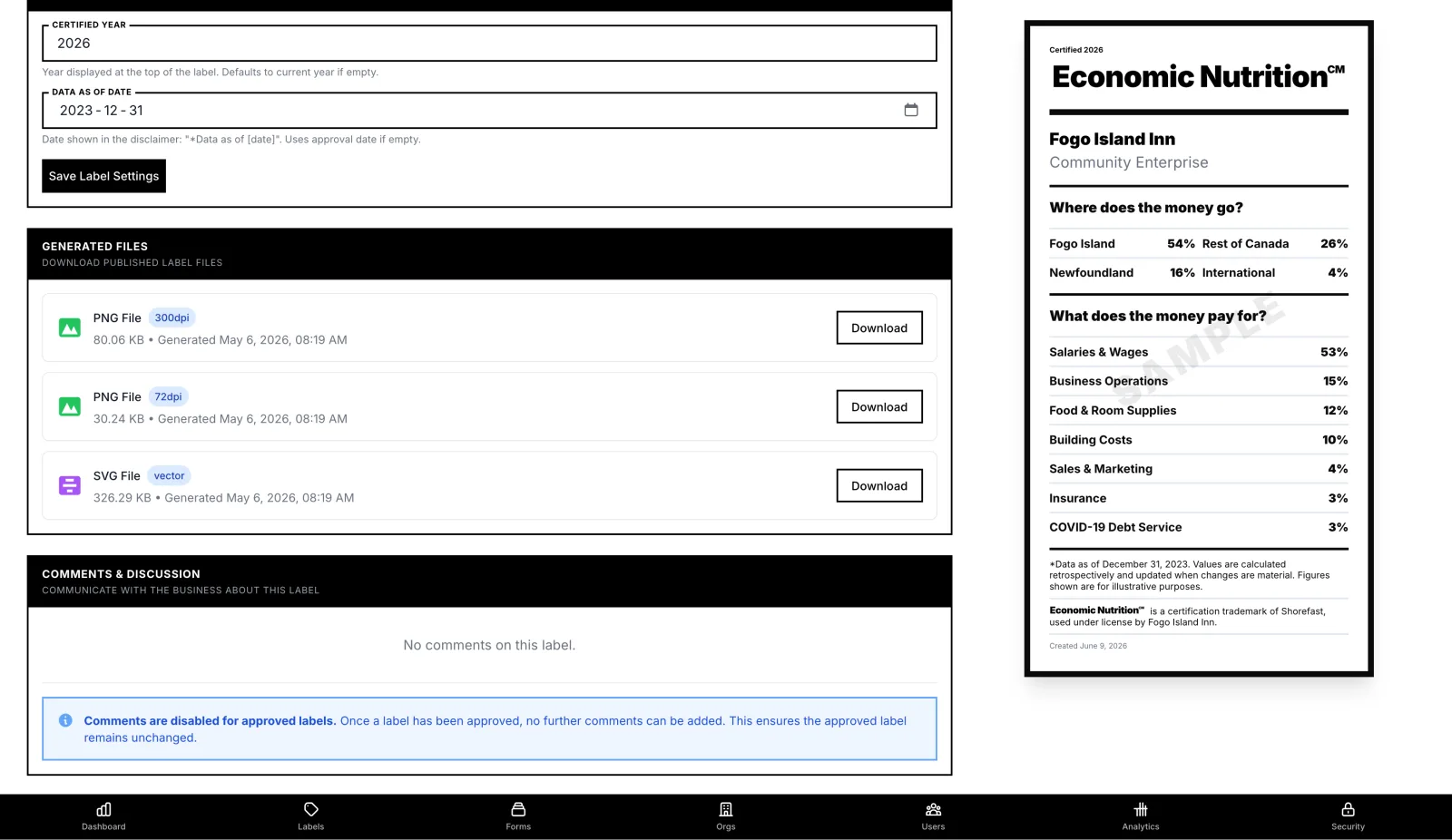
The format borrows from something everyone already knows how to read. A label breaks down two things: where the money goes geographically (Fogo Island 54%, Rest of Canada 26%, and so on) and what it pays for (salaries, operations, supplies). The numbers come from a business's own financial audit. The result is radical transparency, packaged in a form a customer can absorb in seconds.
What I Built
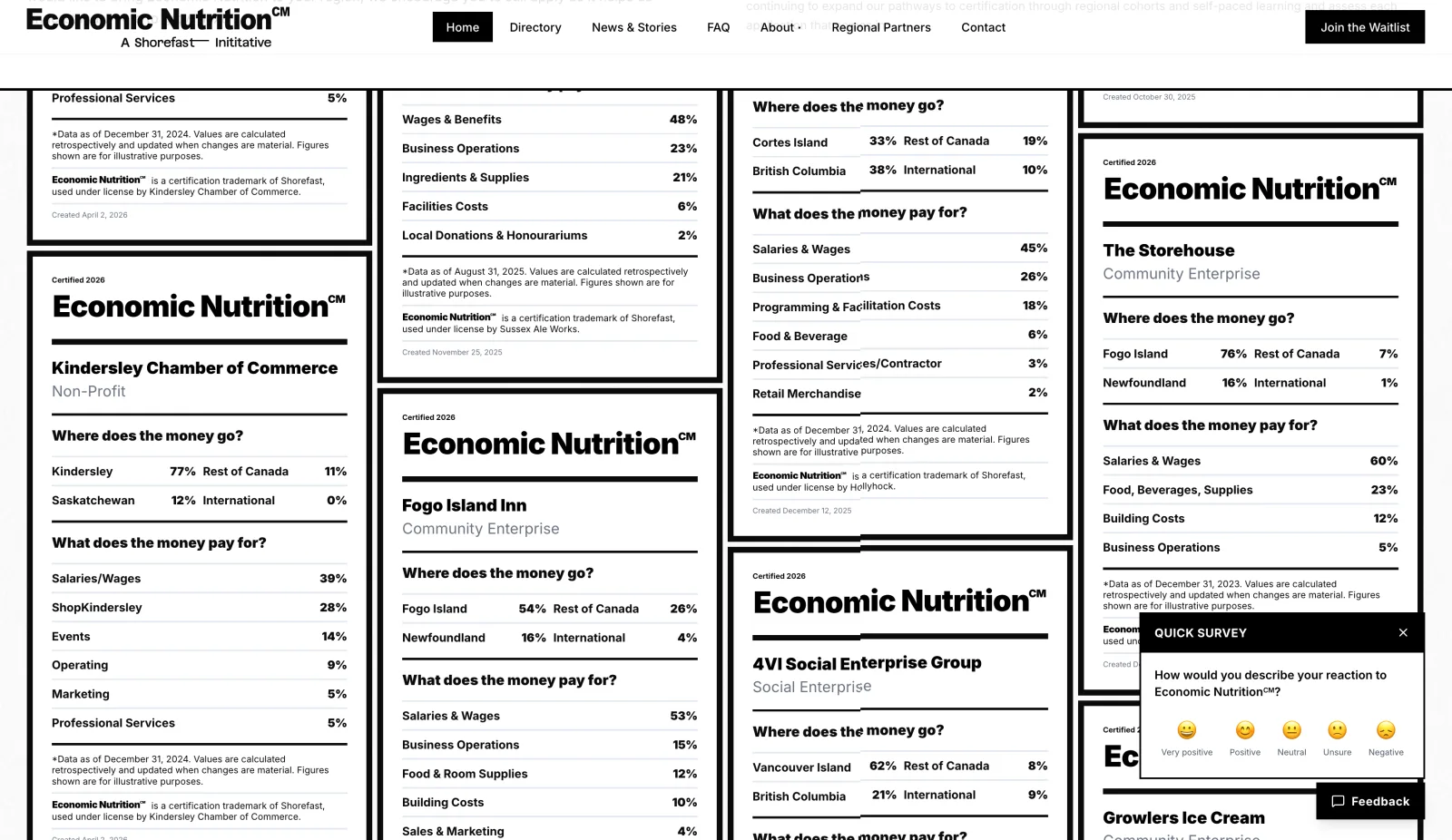
I created the whole digital side of the program. The public site at economicnutrition.com introduces the concept and hosts a directory where anyone can browse certified businesses and read their labels. Behind it sits an internal application where the labels are actually made.
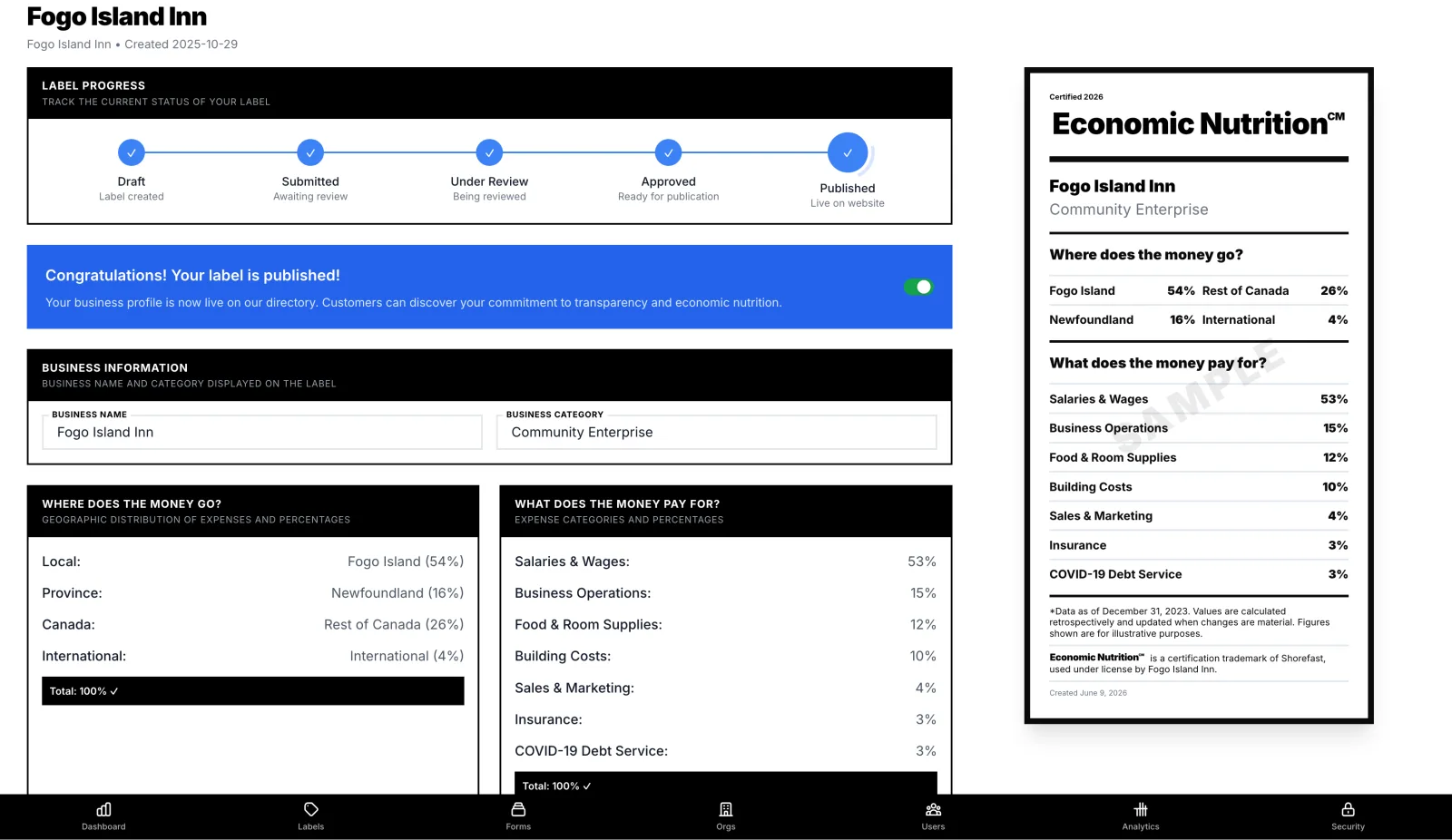
Building a label is a back-and-forth. Once a business's audit is complete and the percentages are set, the label moves through a clear workflow, from draft to submitted, under review, approved, and finally published. Businesses log in to manage their own profile and publish their label when it is ready.
The Generator
The part I am most proud of is the generator. When a label is approved it automatically produces an SVG along with high- and low-resolution images, ready to download. That keeps every label visually identical and means we do not need a designer to hand-build each one as the program grows. Those files also flow straight into our Monday.com board through the API, so internal teams can grab the right graphic for the website, social, or print without asking. Form and contact submissions feed the same system, landing in our CRM automatically.
How It's Built
The platform is a Vite application backed by a PostgreSQL database, with two-factor authentication and role-based scoping: internal staff who manage the whole program, and business owners who see only their own organization or organizations. It is already built to generate labels in both English and French, ready for when the program expands.
Vite for the application and the public marketing site.
PostgreSQL to store businesses, audits, and published labels.
2FA and role-based scoping for secure, properly partitioned access.
Monday.com API to push form entries into the CRM and generated labels onto an organized board.
Bilingual generation in English and French, built in from the start.
Where It Stands
Nine businesses from last year's pilot program have published labels so far, and Shorefast is about to announce the regional cohort partners for the next round. The platform was built to scale with exactly that kind of growth.
Human-Led, AI-Assisted
This one is mostly hand-built: the brand and the design in Illustrator, the platform engineered from the ground up. Claude Code came in as an assistant on the heavier systems, helping me move faster through the more complex parts, the generator, the integrations, the auth and scoping. I set the direction and the design, and used AI to get there sooner.